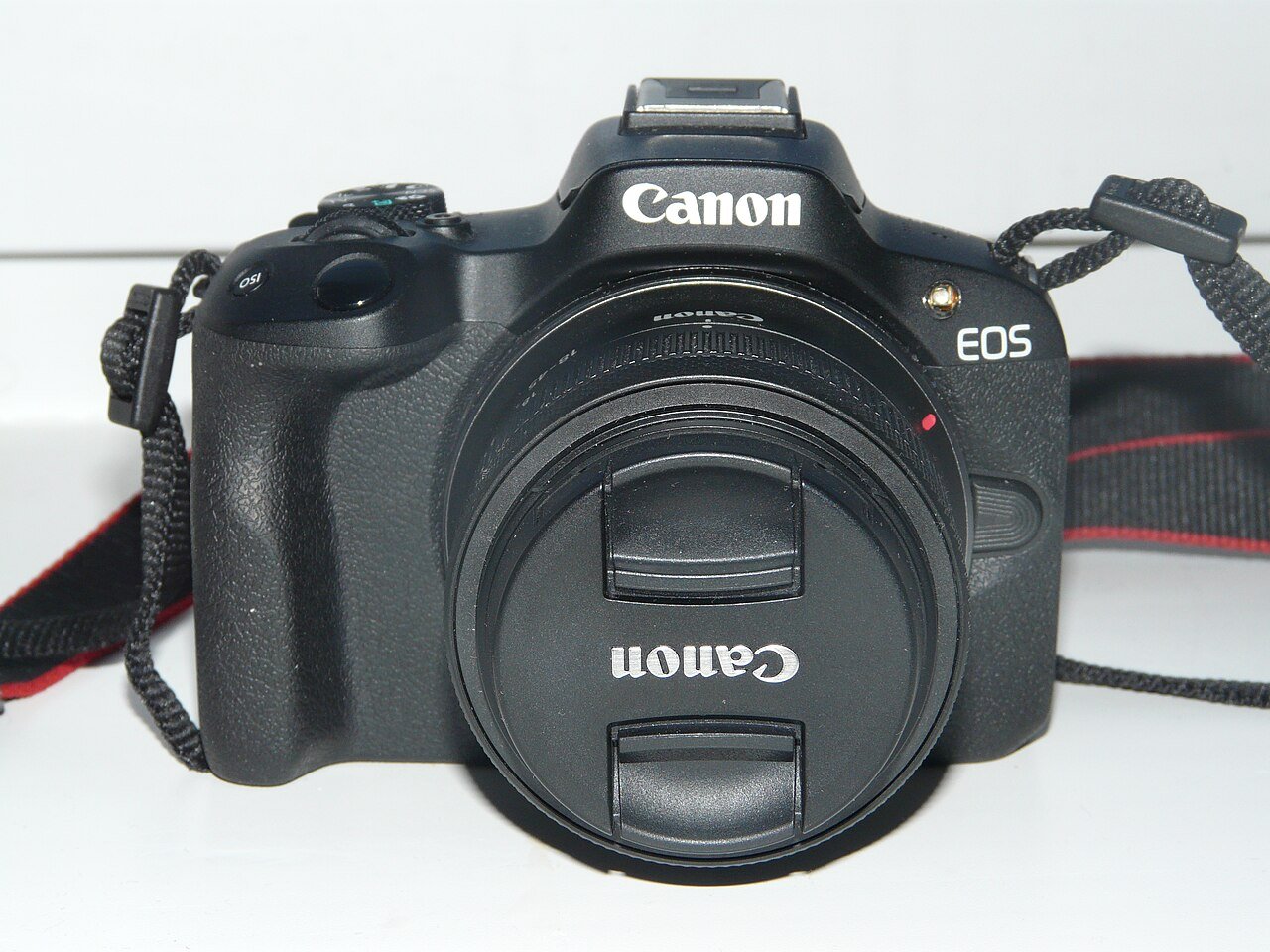
The Canon EOS R50 is one of the most popular first “real” cameras for people moving up from a smartphone. It’s small, easy to learn and has excellent autofocus. But it also has limits that matter if you’re serious about video or plan to shoot in low light. Here’s where it earns its price and where it falls short.
Quick verdict
Buy it if you want an easy, compact camera for travel, family and everyday photos, with good 4K video for social media. Skip it if you need in-body stabilization, weather sealing, long video recordings or a large choice of affordable native lenses.
For most beginners, the R50 with its 18–45mm kit lens is still one of the safest, simplest ways into interchangeable-lens photography.
Specifications at a glance
| Sensor | 24.2MP APS-C CMOS |
|---|---|
| Processor | DIGIC X |
| Lens mount | Canon RF (RF-S and full-frame RF lenses) |
| Autofocus | Dual Pixel CMOS AF II with subject detection (people, animals, vehicles) |
| Burst | Up to 15 fps (electronic first curtain), up to 12 fps (mechanical) |
| Video | 4K 30p oversampled from 6K, Full HD up to 120p |
| Stabilization | No in-body stabilization (lens and digital only) |
| Screen / viewfinder | 3″ fully articulating touchscreen; 2.36M-dot EVF |
| Ports | 3.5mm mic input, USB-C, micro HDMI |
| Weight | About 375g with battery and card |
| Launch price | $679.99 body only; $799.99 with RF-S 18–45mm |
Pros and cons
| Pros | Cons |
|---|---|
| Very small and light | No in-body stabilization |
| Reliable, easy subject-detection autofocus | Small battery; carry a spare |
| Sharp, oversampled 4K video | Single UHS-I card slot, no weather sealing |
| Guided menus for beginners | Limited choice of affordable native RF-S lenses |
| Flip-out screen and mic input | No headphone jack |
Design and handling
The R50 is genuinely pocket-friendly for a camera with a viewfinder. The grip is small but usable, and the fully articulating screen works for selfies, vlogging and shooting from low or high angles. Controls are simplified compared with Canon’s more expensive bodies, and a guided menu mode explains settings in plain language, which is perfect for beginners but can feel limiting once you know what you’re doing.
Image quality
The 24.2MP APS-C sensor produces clean, pleasing photos with Canon’s well-liked color rendering. Detail is more than enough for prints and social media. In low light, the bigger limitation is the slow kit lens rather than the sensor: adding an inexpensive fast prime like the RF 50mm f/1.8 makes a big difference for indoor and evening shots.
Autofocus
Autofocus is the R50’s strongest feature. Dual Pixel AF II detects and tracks eyes, faces, animals and vehicles and is easy to trust, even for beginners. It’s fast enough for kids, pets and casual sports.
Video
4K 30p is oversampled from a 6K readout, so footage is sharp and detailed. Full HD at up to 120p allows slow motion. The main limits are the lack of in-body stabilization (handheld walking shots can look shaky without a stabilized lens or gimbal), a 4K clip limit and no headphone jack. For video-first creators, Canon’s EOS R50 V ($649.99 launch) adds video-focused controls, vertical shooting and a tally lamp, but drops the viewfinder. See our content creator camera list.
Battery and connectivity
The small LP-E17 battery is the weak spot: plan on carrying at least one spare for a full day of shooting or video. You can charge and power the camera over USB-C. Wi-Fi and Bluetooth make transferring photos to your phone easy, and the camera can work as a webcam over USB.
Lenses
The RF mount gives you access to Canon’s full-frame RF lenses as well as compact RF-S lenses, but the choice of small, affordable APS-C lenses is still narrower than Sony E-mount or Fujifilm X-mount. Good starting options:
- RF-S 18–45mm (kit lens): compact everyday zoom.
- RF 50mm f/1.8 STM: cheap portrait and low-light lens.
- RF-S 55–210mm: telephoto for sports, wildlife and kids at a distance.
- RF-S 10–18mm: ultrawide for vlogging, landscapes and interiors.
Alternatives to consider
- Canon EOS R50 V: if you mainly film video and don’t need a viewfinder.
- Sony ZV-E10 II: better for video, wider lens choice, no viewfinder. Also see Sony a6400 vs R50.
- Nikon Z50II: larger grip, more controls and weather resistance at a higher price.
- Fujifilm X-M5: compact, stylish and excellent for film-style color, but no viewfinder.
Price and value
At launch the R50 cost $679.99 body only or $799.99 with the 18–45mm lens. It’s frequently discounted, and the kit is usually the better value. Compare the current kit price against the R50 V and Sony ZV-E10 II before buying.
Frequently asked questions
Is the Canon EOS R50 good for beginners?
Yes. Its guided interface, small body and dependable autofocus make it one of the easiest mirrorless cameras to learn on.
Can the EOS R50 shoot 4K video?
Yes, 4K at up to 30 fps, oversampled from 6K for sharp detail. It doesn’t offer 4K 60p.
Does the EOS R50 have in-body stabilization?
No. Use a stabilized lens, the camera’s digital stabilization or a gimbal for smooth handheld video.
Which memory card should I use?
A name-brand UHS-I SD card rated V30 or faster works well for 4K video.
R50 or R50 V?
Choose the R50 if you shoot mostly photos and want a viewfinder. Choose the R50 V if you mainly film video, especially vertical content.
The bottom line
The Canon EOS R50 is a small, friendly and capable first camera. Its autofocus and 4K video are excellent for the price, and it’s easy to carry everywhere. Its limits, including no stabilization, a small battery and fewer budget lenses, matter more as you grow, but for most beginners buying the kit and a spare battery, it’s a very safe choice.